Укр
Eng

Collaboration between the University of Stuttgart's Center for Computational Design and the school's Institute of Building Structures and Structural Design has resulted in a pavilion that draws from the web-spinning habits of the diving bell spider. The resulting lightweight fiber composite shell forms a pavilion with unique architectural qualities, while at the same time being a highly material-efficient structure. These building prototypes explore application potentials of novel computational design, simulation and fabrication processes in architecture.
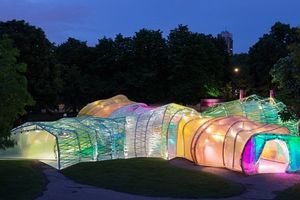 Serpentine pavilion 2015 by SelgasCano was represented this year in The Serpentine Gallery. The 15th Serpentine Gallery Pavilion was designed by Jose Selgas and Lucia Cano, and consists of double-layered plastic skin in a variety of colors, wrapped around a series of metal arches.
 It looks like pavilions and domes theme is rather popular in England. Though, The Eden Project is a clear indication of this fact. The project, designed by architect Nicolas Grimshaw, took two and a half years to construct and opened to the public on March 17, 2001. The complex is dominated by two huge enclosures consisting of adjoining domes that house thousands of plant species, and each enclosure emulates a natural biome.

“2015’s Building of the Year” will be named on November 6 in the framework of The World Architecture Festival in Singapore. Let’s have a look at some of the contenders.

Spiraling self-sufficient eco-skyscraper provides water, food and energy for Noida, India. Here are some more examples of the same concept.

Is it possible to live happily if your home is less than 200 square feet? Let’s have a look.

Le Corbusier – a Swiss-French architect, designer, painter, writer and one of the pioneers of what is now called modern architecture. He developed a set of his own principles that dictated his technique, which he called “the Five Points of a New Architecture” and were most evident in his Villa Savoye.
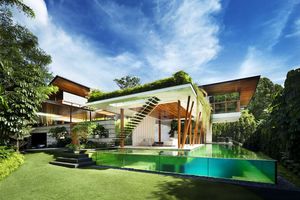 Even nowadays Le Corbusier’s principles have not lost their popularity. Let’s have a look at some contemporary buildings that embody “the Five Points”.


